

Top 5 Calming Apps for Children (And What to Use as an Alternative)
Calming apps?! It’s not uncommon for children diagnosed with ADHD to struggle with anxiety. According to the Centers for Disease Control and Prevention (CDC), about 1 in 3 children diagnosed with ADHD also have an anxiety disorder. Changes to your child’s current routines, such as the quarantine, can also impact his or her mental health.
Many parents find that meditating or practicing mindfulness helps their children focus better and quiet the mind. There are many ways to practice mindfulness, and like most things, there’s an app for that too.
These top five apps can help your child learn to meditate and calm the mind. Many of these apps include guided meditations, which is ideal for children who are new to mindfulness.
The Best Calming Apps for Kids
Here is a roundup of apps that can help your child or teen deal with anxiety and stress:
1. Calm
As the name suggests, Calm is designed to help you or your child feel relaxed and calm. Calm provides daily meditations as well as specific programs, including the popular 7 Days of Calming Anxiety program.
Why we like it: Each meditation is voiced by a soothing and gentle voice, but guided meditations aren’t the only option. Your child can choose to listen to nature sounds too. For younger kids, the Calm app features “sleep stories” to help your child relax at bedtime.
Price: Free to try ($69.99 per year)
Available for: Android, iOS
2. Breathe, Think, Do Sesame
For younger children, a Sesame Street app introduces the concepts of “Breathe, Think, Do” with the characters they already know and love.
Why we like it: Your child learns strategies for calming down by helping an animated monster deal with a frustrating situation. They help the monster by learning to take deep breaths. Plus, your kids will enjoy seeing their favorite Sesame Street characters! You can also find several different lessons on YouTube as well.
Price: Free
Available for: Android, iOS
3. Headspace
Headspace is a popular app for parents, but there is also a kids’ version.
Why we like it: Your child has a lot to choose from in this app: breathing exercises, meditations, and visualizations. Your child can niche down and work on improving focus, sleep, or even kindness. Headspace offers “sleepcasts”, which are stories to help your child drift off to sleep, calming music or nature sounds to listen to, and even anxiety-busting exercises. Guided meditations teach your child what mindfulness is and how to practice it daily.
Price: Free to try ($12.99 per month subscription)
Available for: Android, iOS
4. Stop, Breathe, and Think Kids
Stop, Breathe & Think is a meditation app for middle schooled-aged children.
Why we like it: Not only does this app have breathing exercises, but it also offers written instructions designed to teach kids how to meditate. Your child can log his feelings, and meditations are recommended based on those results.
Price: Free to try ($9.99 per month subscription)
Available for: Android, iOS
5. Super Stretch Yoga
Super Stretch Yoga is technically a yoga app, but yoga can still help teach children how to calm down and practice deep breathing. Your child will learn 12 different yoga poses, and each one includes a short animation as well as a live video. This app is suitable for kids in pre-school up through grade school.
Price: Free
Available for: iOS
Pros and Cons of Using Calming Apps
Calming apps are great for teaching your child strategies to calm down.
But apps aren’t the only way to ease anxieties.
There are some cons to using apps. For example, the bright screen could affect your child’s ability to sleep later on in the evening. (That’s because blue screens like phones, tablets, etc. can disrupt your circadian rhythm.)
However, there are many tech-free ways to help your child calm down. You can try:
- Cuddling under a weighted blanket listening to music
- Listening to mellow or relaxing nature sounds
- Deep breathing exercises without an app
- Yoga or gentle stretching
- Try the 5-4-3-2-1 grounding exercise (you can find an example of this here)
- Coloring
Sometimes just talking can help calm your child. This is especially helpful if there’s something on your child’s mind that is bothering him or her. Go for a walk around the block and let your child open up to you.
“I do not usually suggest a lot of apps for kids. I usually focus on coaching and training the parent on the techniques, so that they can then teach/model/walk the kiddo through the technique at home.”
Monica Clark, LPA
This means that you can not only help calm your child down, but you can also use that a chance to help strengthen your relationship even more.
Do Calming Strategies Really Work?
Calming strategies work differently depending on which method you choose. Breathing exercises, for example, promote calmness because the act of deep breathing sends a message to your child’s brain to calm down and relax. Deep breathing shifts your child’s body into the parasympathetic nervous system. This is the opposite of flight-or-fight mode. And as a result, your child’s heart rate slows down, breathing rate returns to normal, and he or she feels relaxed.
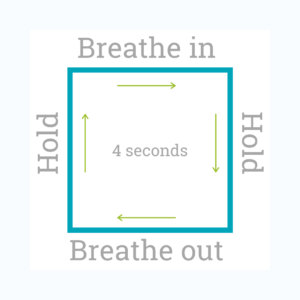
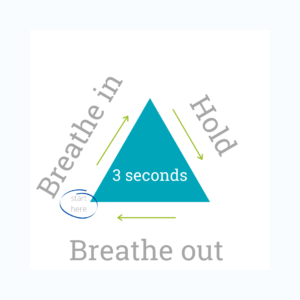
You can encourage your child to try different types of deep breathing such as square breathing or triangle breathing.
On the other hand, activities like coloring, promote calmness in a different way. Coloring, like other forms of meditation, can relax the amygdala, or the fear center in your child’s brain. This is why coloring and meditation can quiet a restless mind.
Need More Managing Intense Emotions and Anxiety?
Managing intense emotions can be difficult for children with ADHD, and unmanaged ADHD can contribute to emotional dysregulation. If your child is struggling with symptoms of ADHD, we can help. Here at Next Step, we generally recommend comprehensive and holistic treatment approaches. Our team-based, multidisciplinary approach includes therapy, education, coaching, medication, and more. Our compassionate and understanding providers are experienced in treating children with co-occurring disorders such as anxiety and ADHD.
If you’d like to learn more about us or set up a confidential discussion with one of our professionals, you can request an appointment here. Alternatively, call our Louisville, Kentucky office at (502) 907-5908.
References:
Price and availability may vary but were accurate as of June 20, 2020. NextStep 4 ADHD does not endorse or receive financial compensation for the sale of any of these apps.
Learn More
What to Do When Your Spouse Has ADHD
Untreated ADHD can impact adults in many ways — from disorganization at work to relationship struggles at home. When it comes to relationships, ADHD can have a significant impact on marriages.
There’s good news though: the reality is that you can thrive and your marriage can grow and be healthy. Here at Next Step 4 ADHD, we’re dedicated to helping you thrive with coaching, medication, therapy, and on-going support. If your spouse is newly diagnosed with ADHD, you might have many questions, and that’s okay. We can help.
In the meantime, we’ve created this guide to help you learn a little bit more about how ADHD can impact a marriage.
How Does ADHD Affect Marriage?
ADHD can affect marriage in a variety of ways. “It shows up different ways in different marriages. Sometimes it affects communication. Sometimes it affects the family finances. And sometimes it can lead to deeply, deeply seated resentments in the marriages,” says Dr. Briscoe.
Even though ADHD impacts relationships, you can still have a healthy, thriving marriage. The first step is to acknowledge all of the ways that ADHD is affecting your marriage.
Here are a few ways that ADHD impacts marriage.
For the non-affected spouse (i.e., the person who does not have ADHD):
- Can harbor some resentment over having to take responsibility for: finishing off projects, ensuring appointments are kept, picking up the house, tying off loose ends, planning, paying bills, etc.
- Can get stuck in an unhealthy role of a “parent” figure in the relationship, which eventually leads to resentment within the spouse with ADHD.
- May come to see their partner as “lazy” or “irresponsible.”
For the affected spouse (i.e., the person who has ADHD):
- May feel a sense of shame or guilt over not completing projects, dropping balls, or maintaining certain forms of employment.
- May feel like “a failure.”
- May grow to resent the non-ADHD’s partner’s subtle comments RE: his or her perceived mistakes or failures.
- May act on impulse and engage in promiscuous or risky behaviors that place the marriage in jeopardy.
- Because ADHD can one’s ability to regulate both attention and emotion, the spouse with ADHD may experience emotions very intensely and have a difficult time reigning them in quickly. Emotional dysregulation, if present, can have an effect on the flow of conversations, the discourse of arguments, and relationships in general. (Learn how to regulate emotions here.)
If both spouses have ADHD:
Dr. Briscoe reminds us that ADHD doesn’t necessarily just impact one spouse. Sometimes both spouses might have it. “If both partners in a relationship have ADHD, things can be interesting. Sometimes fun, but also a little chaotic at times,” he says.
I Just Found Out My Spouse Has ADHD… How Do We Move Forward As a Couple?
The scenario is all too common:
- Spouse without ADHD: “I’m the only one around here who does anything. Why can’t you just do the one thing I ask?”
- Spouse with ADHD: “I don’t want to be around so much nagging.”
When ADHD is untreated among one (or both) spouses, it can lead to increased frustrations, arguments, and even distancing (or walling up). Unmanaged ADHD can lead to disharmonious situations including:
- One partner acting like “the parent” of the other spouse
- Frequent fights or squabbles
- The feeling like one spouse is “tuned out” of the marriage
- Arguments about finances, household chores, or to-do lists
- Sexual dissatisfaction
- The feeling of inadequacy or letting the other spouse down
Unhappiness and marital dysfunction can result as a result of these issues. However, receiving a proper diagnosis is the first step on the path towards healing the individual as well as the marriage. For example, a spouse might have called his/her partner “lazy” but — with a diagnosis — now understands that unmanaged ADHD was creating challenges and obstacles in the relationship.
So how do you move forward as a couple?
“Couples’ therapy can be very helpful for marriages affected by ADHD,” says Dr. Brian Briscoe. In addition to couples’ therapy, it’s important for couples to learn more about ADHD itself (including about ADHD treatment options) as well as how ADHD affects marriages. Reading books can be a great way to learn strategies for rebuilding your marriage.
Dr. Briscoe also recommends The ADHD Effect on Marriage: Understand and Rebuild Your Relationship in Six Steps. Dr. Briscoe continues, “Melissa Orlov is a respected author who has written a number of books on the topic of ADHD and marriage and the effects of ADHD on couples. Her texts are widely read and recommended by many therapists and physicians across the country.” In fact, HuffPost lists this book as “one of the top 15 books recommended by therapists.”
My Spouse Has ADHD. How Do I Support a Partner with ADHD?
The first way to support a spouse with ADHD (or any other mental health condition) is to educate yourself on the condition. Dr. Briscoe continues, “If your spouse has ADHD, the first thing that you can do first is to learn everything you can about adult ADHD. A good starting point is Ed Hallowell’s book Driven from Distraction. Then read Melissa Orlov’s books on Marriage and ADHD.
The more you understand what is going on with your spouse, the more you will be able to empathize with his or her situation.”
Next, take some time to sit down with your spouse.
- Ask them “Tell me what it is like to walk in your shoes.” “Tell me what it is like living with ADHD.”
- Don’t say a word. Just listen.
- If you have to say something, ask followup questions to gain a deeper understanding of their experience.
- Listen to understand, not to fix.
- Try to truly understand every aspect of what their life and world is like living with this condition.
Revisit this conversation every once in a while. This exercise will not only show your spouse that you truly care about them (and score you some big points in the love bucket), but also help you to truly understand them- so that the next time that you feel frustrated when they drop the ball, run late, or just plain blow it, you will naturally have a higher level of patience and peace.”
“Be kind, for everyone is fighting a hard battle. And if you really want to see what people are, all you have to do is look.”
– Auggie Pullman. Wonder 2017.
Is ADHD Impacting Your Marriage?
About Dr. Briscoe
 Dr. Brian Briscoe is a board-certified psychiatrist and the medical director of adult programs at Next Step 4 ADHD. Dr. Briscoe was voted a “Top Doctor” by Louisville Magazine. You can make an appointment with Dr. Briscoe here .

Five Ways to Improve Emotional Regulation
Dealing with uncomfortable feelings is a shared human experience. We all encounter a range of emotions, and sometimes we even experience multiple emotions at once. Frustration, jealousy, anger, and grief are just a few examples of uncomfortable emotions – but we have a tool to help us manage those emotions. Emotional regulation helps us keep our reactions under control – rather than our emotions controlling our reactions. By regulating and managing our emotions, we can better respond to life’s difficulties in healthy and socially appropriate ways.
In this post, we’ll explore:
- What emotional regulation is
- What emotional dysregulation is
- Five ways to improve emotional regulation
What Is Emotional Dysregulation?
Emotional dysregulation refers to an inability to modulate one’s emotional experience and expression and is characterized by extreme responses to emotions.
Individuals diagnosed with ADHD frequently experiences challenges in regulating their emotions.
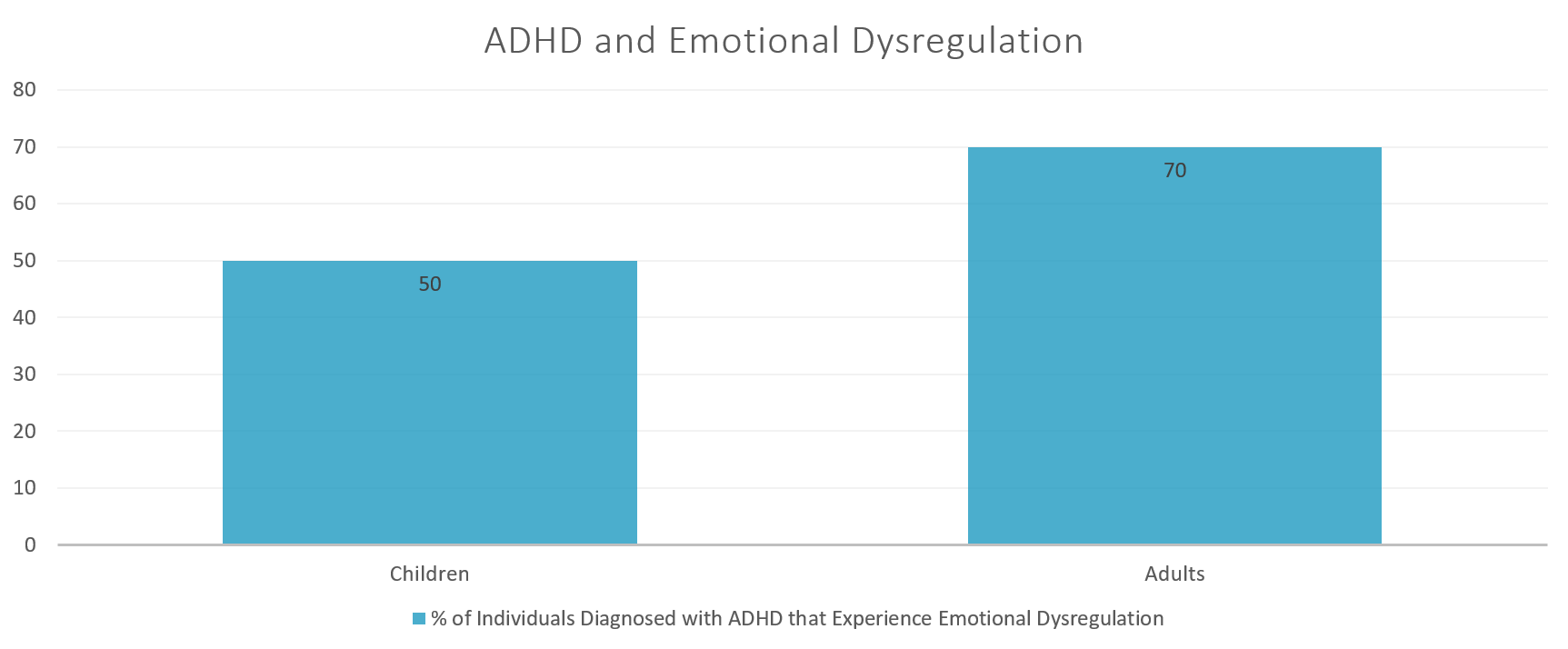
Shaw and associates (2014) estimated that the prevalence of emotional dysregulation in children with ADHD to be between 24 and 50%, while the prevalence in adults diagnosed with ADHD to be around 70%. These challenges are far more detrimental to an individual’s sense of self-worth and wellbeing than the core symptoms of ADHD (Shaw et al., 2014).
What Causes Emotional Dysregulation?
Poor regulation of emotions in individuals with ADHD is likely the result of poor executive function control [1], which leads to the following:
- Impatience and low frustration tolerance, quickness to anger, reactive aggression and temper outbursts, and increased mood swings.
- Problems regulating emotional responses, leading individuals with ADHD to experience intense and overwhelming emotional reactions. Additionally, individuals with ADHD may find it difficult to inhibit their behavioral responses to the emotions and may find it challenging to moderate the intensity of the emotion.
- Difficulty refocusing attention away from the strong emotion, which leads to difficulties with ruminating thoughts.
- Poor self-soothing. Self-soothing is used to moderate the emotional response and individuals with ADHD, as a result of poor working memory, may struggle to use typical self-soothing strategies, such as self-speech and visual imagery.
- Difficulty organizing and executing appropriate responses due to poor cognitive flexibility in the area of manipulating and organizing information, generating and appraising possible responses and potential outcomes, and planning an appropriate response.
These above deficits lead to the following struggles in daily living [1]:
- Experiencing and displaying emotions more intensely, especially in relationships
- Becoming overly excited
- Focusing on negative aspects of a task/situation
- Experiencing social problems, including social rejection, bullying, and isolation
- Experiencing marital problems, relationship breakups, and divorce
- Having difficulties achieving academic or occupational goals, receiving disciplinary measures in the school or workplace, failure to be promoted, or loss of employment
- Experiencing agitation during driving, including being involved in road rage incidents or car accidents
- Feeling distressed by emotional experiences, leading to the development of anxiety and/or depression
- Having more conduct problems, including being involved in crime or other activities that result in institutionalization
However, despite these struggles, it is possible to increase emotional regulation in people with and without ADHD. Here’s what you need to know.
1. Focus on Prevention.
Preventative techniques help by decreasing vulnerability to strong emotions. The best way to modulate a strong emotion is to prevent the emotional experience from being overwhelming. The following areas will help to prevent strong emotional responses:
Treat physical illness
Routine illnesses (i.e. colds, flu) and pain make us vulnerable to increased emotional volatility. Appropriate treatments of these conditions are vital. Take medication and vitamin supplements, as prescribed, and schedule an appointment with your medical doctor if you do not feel well.
Eat well
Eating regularly and with a focus on nutrition will improve your body’s ability to regulate itself. Eating every few hours will serve to keep your blood sugar and energy stable. You should focus on eating a balanced meal with a focus on ensuring that you are eating enough fruits and vegetables. Avoid too large portions that may lead to physical discomfort due to overeating and avoid or limit foods high in sugar, fat, and caffeine.
Avoid mood altering drugs and substances
Take only medications that are prescribed by a doctor. Drink alcohol only in moderation, preferably only drink on weekends or days off work, and only in moderation on those days. Avoid illegal substances or non-prescribed medications completely. Using drugs and alcohol increases susceptibility and vulnerability to strong emotions and this vulnerability persists for one to two days following use.
Get good sleep
Most people need 8 to 10 hours of sleep per night. Practice good sleep hygiene by unplugging from electronics at least an hour before bed, go to sleep the same time every night, and turn the light off completely at least 15 minutes before you would like to be asleep. Avoid naps during the day to improve the quality of your sleep at night. If you feel that you must nap, limit the nap to 15 to 30 minutes.
Get plenty of exercise
Remember that exercise leads to a boost of mood regulating chemicals in the brain and provides an outlet for burning off excess energy that stems from stress or frustration. Aim to exercise 20 to 30 minutes each day.
Do one thing each day to obtain a sense of mastery
Feeling that you have mastered something gives you a sense of accomplishment, capability, and confidence. Mastered task may be completion of daily responsibilities, such as household cleaning, learning a new task, or enhancing mastery in a task that you already know.
2. Cope ahead, when possible.
This simply means planning for events that you know will trigger a strong emotional response. Identify types of situations that typically evoke a strong reaction for you and identify what you need to feel more in control and prepared for the situation. Then, follow through with what works.
Preparation techniques may take the form of role play to prepare for a difficult situation, carrying an item to remind you of your coping strategies, and using your self-soothing skills (more on this later) in the moments before the event is to occur. Do not be discouraged and give up if initial coping attempts are not successful. Sometimes, it takes some trial and error to find a plan that works. Remember to practice your coping strategies routinely, even when calm, so that you are more comfortable and able to use the techniques effectively when upset. Times of emotional upset are not the correct time to be practicing a new skill.
Just like a basketball team does not learn a new play during the game, plays are learned and practiced beforehand.
Coping skills work the same way.
3. Be mindful by being present in the moment.
It is not an uncommon experience during times of emotional upset that your thoughts begin to spiral, reminding you of previous times when similar situations have occurred and have not gone well. This creates more anxiety and increases the risk of failure in the present situation. Keep your focus on the current situation and your plan for dealing with strong emotions.
Use grounding techniques
If you find yourself beginning to lose focus, ground yourself in the moment. One effective grounding technique is the 5-4-3-2-1 Game. In this technique, you ground yourself in the physical environment by naming
- 5 things you can see
- 4 things you can hear
- 3 things you can feel against your skin
- 2 things you can smell
- 1 thing you can taste
If this feels too complicated for you, just remember to ground yourself in your current environment using the five senses. A more simplistic grounding technique would be to count the number of different colors you can see in your environment.
4. Identify Negative Patterns of Thinking
Be mindful by being aware of unrealistic or negative patterns of thinking that lead to strong emotional reactions. Negative and distorted thinking comes in many different forms and leads to strong emotional responses that are based on your automatic misinterpretation of the situation. The following are some of the most common types of negative thoughts:
• All-or Nothing Thinking: This is a type of thinking where you see only the extremes. Something is awful or wonderful; people love you or hate you. This type of thinking sees the world in black-and-white while ignoring the entire gray in between.
• Overgeneralization: This type of thinking makes assumptions that something is true based upon one or two previous experiences. For instance, you may think that you are a failure because you received unsatisfactory feedback from your boss on one assignment.
• Mental Filter: This type of thinking refers to filtering out all positive experiences and focusing only on negative experiences. For instance, if you give a presentation at work and get tongue tied on one part, you may fixate only on that one part rather than the overall presentation, which was good.
• Mind Reading: This type of thinking refers to assuming that you know what someone else is thinking or know why they do a particular action. For instance, you may assume that someone does not respond to your question because they are ignoring you or because they do not care about you or your feelings. We never truly know what someone else is thinking or why they act the way they act. By assuming you do know, you are more likely to misinterpret their actions and react by becoming frustrated, angry, and overwhelmed.
• Emotional Reasoning: This type of thinking refers to the belief that what you feel is true. I feel like a failure, so that means I am a failure.
• Catastrophizing: This refers to the belief that the worst case scenario is going to happen or that the most extreme interpretation of the situation is the truth. For example, if you do poorly on a work project, you may assume that you are a terrible employee, that you will be fired, and never find employment again. This leads to strong reactions of stress and defensiveness due to a belief that you need to defend yourself against this terrible outcome.
WHAT TO DO IF YOU’RE EXPERIENCING NEGATIVE THOUGHTS: There are many other types of negative thinking that leads to strong emotions. A good rule is, if you feel a strong emotional reaction, stop and identify what you are thinking. Then, ask yourself if your belief is supported by the situation. If not, mentally tell yourself all of the evidence that you see and know that proves that your thoughts are not based in reality. Then, identify a more balanced thought. For example, if you believe that you are going to be fired because you were not successful on a single work assignment (catastrophizing), you may tell yourself that, while you made a mistake on this assignment, you did well on all of the other assignments and expectations that you have been given and that your boss compliments your frequently on your good work. The more balanced thought would be, “While I made a mistake, I’m not likely to get fired for one mistake.”
5. Practice good self-soothing techniques.
It is important that you learn and implement ways to calm your physical and emotional responses in difficult situations. When you recognize that your emotions are becoming overwhelming, separate yourself from the triggering situation to de-escalate yourself. The following are some suggestions for techniques that some people find beneficial:
Diaphragmatic breathing
Take a deep breath through your nose and allow it to fill your lungs, causing your diaphragm to rise. Then, breathe out slowly. Hint: If you put your hands on your stomach, you should be able to see them rise if you are breathing correctly. Using either a square or triangle breathing approach is also helpful. Square breathing involves breathing in for 4 seconds, holding for 4 seconds, breathing out for 4 seconds, and wait for 4 seconds before repeating. Triangle breathing is the same minus the final step of waiting, so breathe in, hold, breathe out, and then immediately repeat.
Meditation or guided imagery
There are many different types of meditation and guided imagery. For guided imagery, imagine yourself somewhere peaceful or relaxing. The place may be real or imaginary. Using your five senses, focus on exploring this peaceful or relaxing location, immersing yourself fully in the experience and imagining yourself in that environment. If this feels too complicated, some people find that simply allowing troubling thoughts to empty from the mind to be more beneficial. One method of doing this is to imagine yourself lying by a stream. When a thought enters your head, imagine it leaving your mind immediately and being taken away by the flowing water.
Progressive muscle relaxation
This involves systematically tightening and relaxing your muscles beginning at your feet and continuing until you reach the top of your head. You continue this activity until your body feels relaxed.
Once you feel that your emotions have reached a tolerable level, return to the situation and attempt to find a resolution.
About the Author
 This post was written by Monica Clark, LPA.
You can request an appointment with Monica here.
References
- Barkley, R.A. (2015). Attention Deficit Hyperactivity Disorder: A Handbook for Diagnosis and Treatment, 4th ed. New York: Guilford Publications.
- Emotional Self-Regulation. Copyright 2017. Thriving with ADHD, Perth, Western Australia. Retrieved from https://thrivingwithadhd.com.au/emotional-dysregulation/
Shaw, P., Stringaris, A., Nigg, J. & Leibenluft, E. (2014). Emotional dysregulation and Attention Deficit/Hyperactivity Disorder. American Journal of Psychiatry, 171(3): 276-293.

Attention Versus Memory: What’s the Difference?
Inattention Is a Common ADHD Symptom…
- Difficulty paying attention
- Forgetfulness
- Difficulty listening to others
- Problems paying attention with fine details
- Easily distracted
- Poor organizational skills
- Poor time management
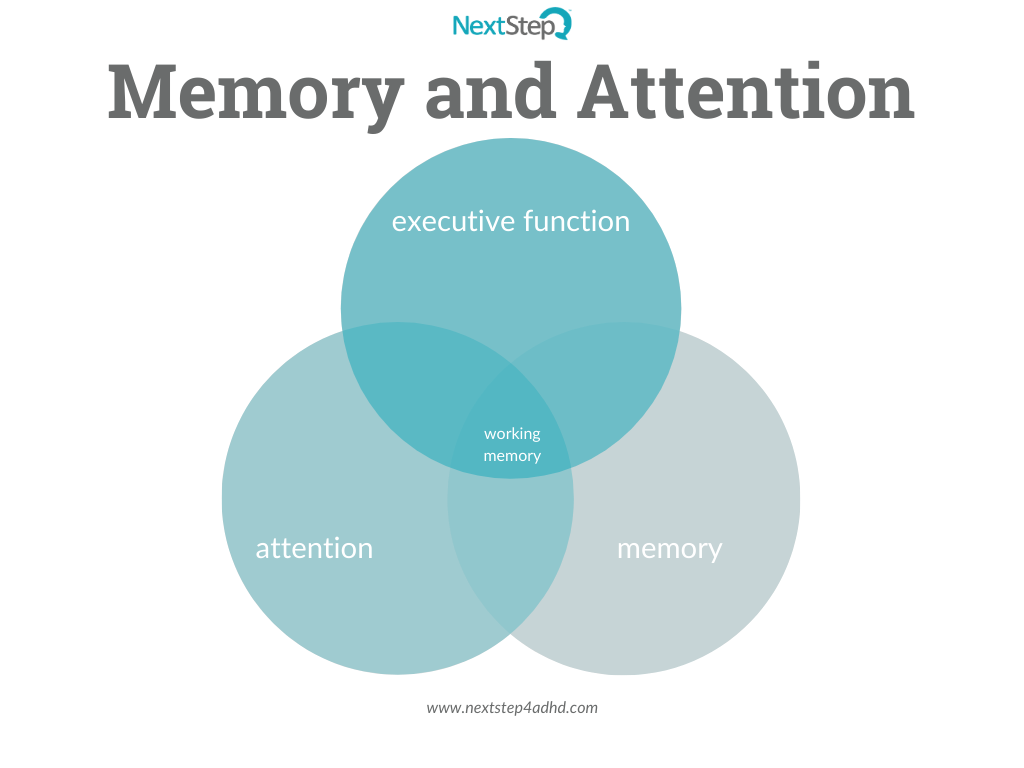
Attention Versus Memory
ADHD and Memory Q & A
Below you can read our interview with Dr. Briscoe.
Q: How many people with ADHD struggle with memory?
ADHD typically does not affect long-term memory — one’s ability to recall memories from childhood, adolescence, and previous years.
- Attention
- Working Memory
Q: How does ADHD affect memory?
Q: How does memory work?
- If your boss sits you down to explain a 4-step process to complete a work assignment, the part of your brain responsible for “working memory” holds those four steps in your mind as he explains the details of the assignment.
- As you think through all the details of the assignment, the resources required to complete the processes involved, your working memory should retain the basic 4 steps as the “big picture.”
- Moreover, your working memory should also be working in full force to help you process the details of each step involved.
- As you listen to your boss, you are actively relying on your short-term working memory to recall the “big picture”, understand how the details of each step fit under your bosses’ primary objectives for the project, and analyze all the information as you think through all the various processes involved in completing the project.
You didn’t “forget.” You were not “lazy.” Rather, your working memory is not the same as it is in the average population and it affected your performance.
Q: How can memory be improved?
Your Next Steps
About Dr. Briscoe
Dr. Brian Briscoe is a board-certified psychiatrist and the medical director of adult programs at Next Step 4 ADHD. Dr. Briscoe was voted a “Top Doctor” by Louisville Magazine. You can make an appointment with Dr. Briscoe here.

What Are Executive Function Skills?
Do you ever feel like you’ve got a lot of information coming in and out of your brain? That maybe you just need a CEO or perhaps an air traffic controller in your mind to make sense of all the data coming in and out? Well, you do! Your brain uses a special skill set to help you plan, remember phone numbers or instructions, focus your attention, and juggle multiple tasks at once. This special skill set also helps you set goals, control impulses, prioritize tasks, and filter out distractions. What are these skills? They are called executive function skills.
In this post, we’ll cover:
- What executive function skills are
- How they impact child development
- How they affect adults with ADHD
- Strategies to strengthen your executive functions
What Are Executive Function Skills?
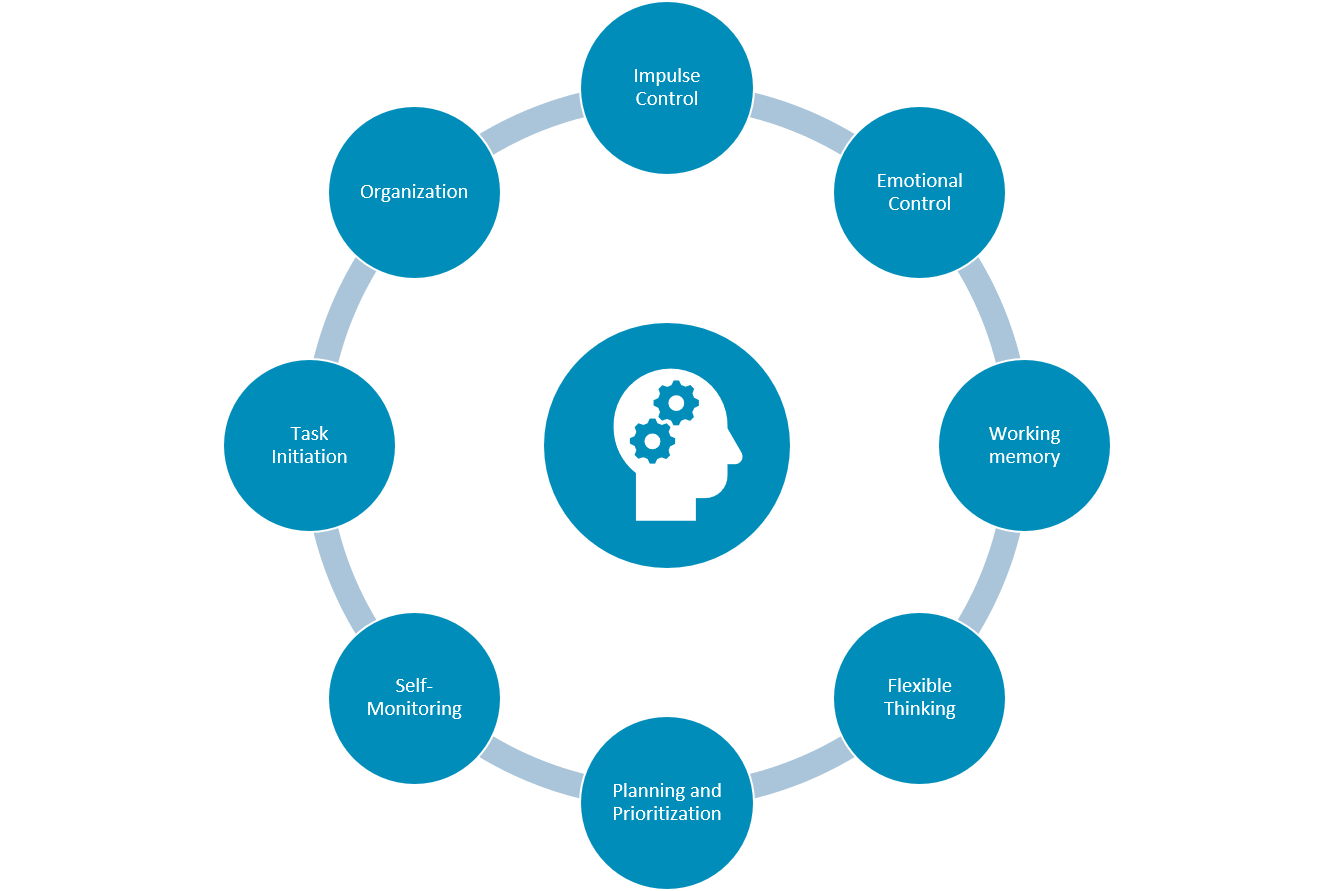
Executive function skills are a set of skills that help you with daily life. These mental skills include:
- Working memory
- Emotional self-regulation
- Flexible thinking
- Self-monitoring
- Planning and prioritization
- Organizing
- Task initiation
- Impulse control
Working memory (non-verbal and verbal)
Working memory helps you keep information in your mind. This can be as simple as a phone number, an address, or to recall a story that a friend told you. Non-verbal working memory allows you to remember something that can’t be spoken or written e.g., the scent of baking chocolate chip cookies or the melody of your favorite song.
Emotional self-regulation
Flexible thinking
Sometimes our day doesn’t go just how we think it will. If you’re able to “go with the flow” and adapt to schedule changes, you can thank flexible thinking. Flexible thinking is a skill that allows you to adjust to the unexpected. Children who struggle with flexible thinking may have a temper tantrum when the schedule deviates from what was expected.
Self-monitoring
Self-monitoring is a skill in which you monitor your own progress. This can look like many things:
- A child who suspects he is doing well in school (and is)
- An adult who gauges progress on projects at work and has an accurate impression of how well he or she is doing
If you have weak self-monitoring, you might be surprised by a bad grade.
Planning and prioritizing
Planning and prioritizing refers to the skill set for planning goals, creating the steps to reach that goal, and then accomplishing that goal. Planning and prioritizing is important for all aspects of life including running a household, reaching goals at work, and setting personal goals — including fitness goals.
Organizing
When most people think about organizing, they think about organizing a desk or closet. Planning and organization are two skills that help you keep track of your physical items, but it’s much more than that. Part of staying organized is about organizing your thoughts too!
Task initiation
In the running world, there’s a quote: “the hardest step is just getting out of the door.” This means that a runner may have no problems going for a 5-mile jog, but just getting dressed and out the door can be the most difficult part. This is task initiation at work– the ability to start projects or tasks. This can include:
- Projects at work
- Homework after school
- Household chores or tasks
Impulse control
Sometimes called inhibition, impulse control is best defined as “thinking before acting.” Individuals with weak inhibition may be more prone to blurting out answers, quickly speaking before reflecting, and engaging in risky behaviors.
Executive Function Skills Are Built
No one is born with executive function skills. They are learned! Children can start developing these skills at a very early age. For example, playing memory match games with your child is a fun way to help strengthen his or her working memory. According to the experts at Harvard Health, there are three phases in life in which executive function skills develop most rapidly. These are:
- Young childhood (about 3-5 years old)
- Adolescent years
- Early adulthood
Signs of Trouble with Executive Function Skills
Trouble with executive function can create obstacles for child and adults. Remember, this is a skill set. We aren’t born with these skills, but we grow and develop them over time. However, if individuals with ADHD can struggle with executive function deficits. This can make it hard for you (or your child) to focus, follow directions, manage time, manage intense emotions and more.
You might suspect that you are struggling with executive function if:
- You have trouble managing your time at home or at work
- You frequently misplace your items
- You have trouble organizing your thoughts
- You struggle to manage intense emotions
- You have difficulty transitioning between tasks
- You dislike when routines deviate from the norm
- You quickly forget information that you just read
- You struggle to finish tasks or projects
Children, too, can struggle with these. You might notice that your child has a hard time switching from play time or reading time. You might also notice that she or he shows time blindness.
Your Next Steps

Is It ADHD? It Could Be Anxiety
Can’t concentrate? Struggling with focus? It’s tempting to think you’re dealing with ADHD, but could anxiety be the culprit? Anxiety and ADHD are very different mental health conditions, but sometimes they share similar symptoms (like not being able to concentrate). To make it more confusing, sometimes both conditions occur at once. According to the National Resource Center on ADHD, about 53% of adults and 30% of children with ADHD also have anxiety.
To help shed light on the issue, we’ve talked to Dr. Brian Briscoe. In this post, we’ll answer all of your questions, including:
- What are the “look-alike” symptoms between anxiety and ADHD?
- What are the symptoms of anxiety? What are the symptoms of ADHD?
- How do I know if I’m dealing with ADHD and anxiety?
- How are co-occurring disorders are treated?
What Are the Common Symptoms of ADHD and Anxiety?
Before we dive into the shared symptoms of ADHD and anxiety, let’s look at each condition separately.
Symptoms of ADHD
There are three main categories of ADHD symptoms: inattentiveness, impulsivity, hyperactivity. As a result, some of the common signs and symptoms of ADHD include:
- Impulsiveness
- Poor time management skills
- Disorganization and problems prioritizing tasks or projects
- Problems focusing on a task
- Trouble multitasking
- Excessive activity or restlessness
- Poor planning
- Low frustration tolerance
- Difficulty concentrating
Symptoms of anxiety
There are many types of anxiety disorders, including OCD and generalized anxiety disorder. Symptoms vary depending on which type of anxiety disorder is present. Common symptoms of generalized anxiety disorder include:
- Feeling intensely nervous
- Feeling restless
- Increased heart rate
- Breathing rapidly
- Sweating
- Trembling
- Feeling weak or fatigued
- Trouble concentrating
- Difficulty thinking about things other than the present worry
Anxiety can also cause physical symptoms such as headaches, muscle tension, and an upset stomach.
The Link Between ADHD and Anxiety
Anxiety can lead to distractibility
ADHD can lead to anxiety
Shared symptoms of anxiety and ADHD
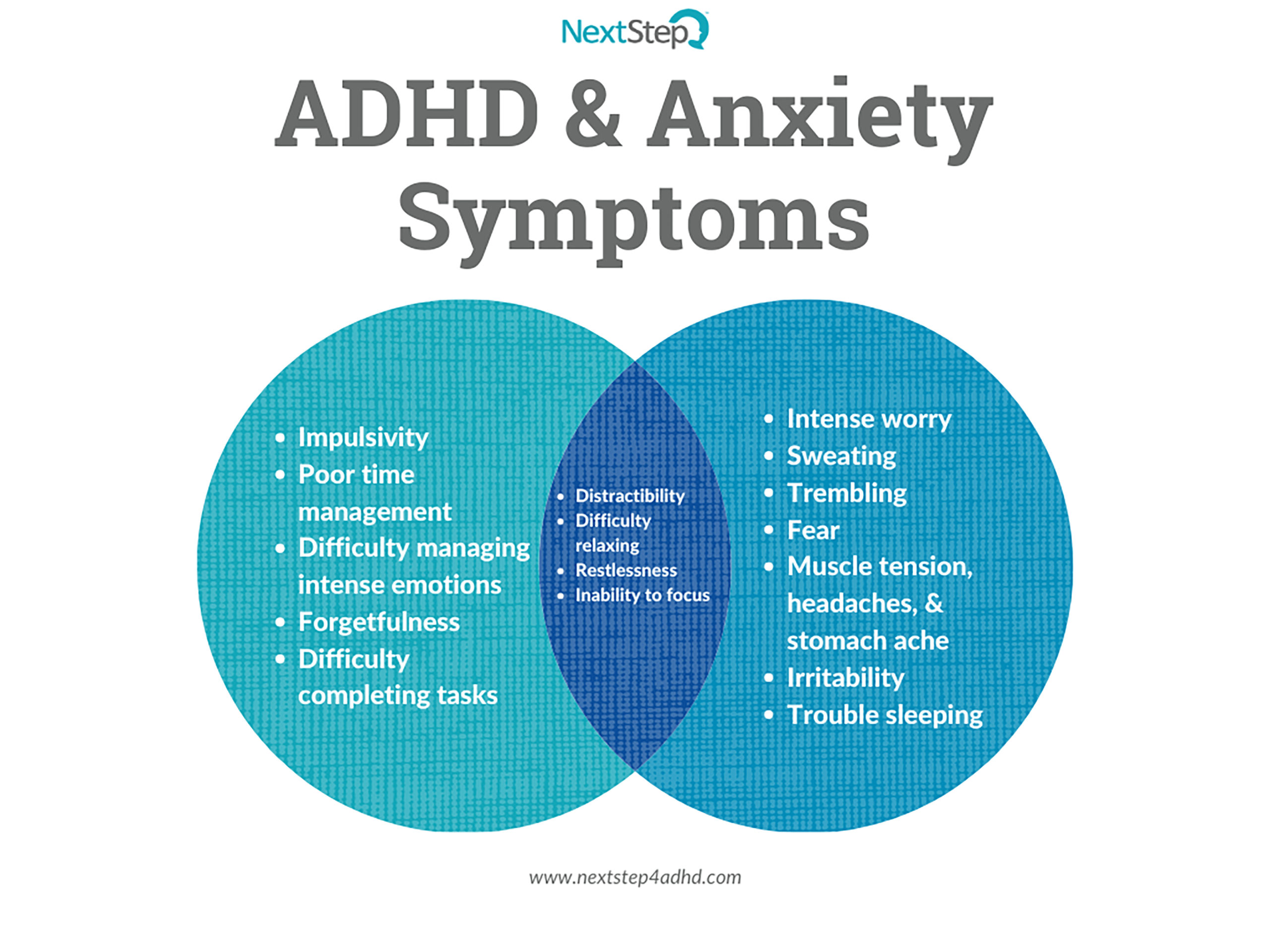
We’ve just covered the symptoms of ADHD, the symptoms of anxiety, and how the two can be linked. The most common look-alike symptoms include:
- Distractibility
- Inability to focus
- Difficulty relaxing
- Feelings of restlessness
What to Do If You’re Dealing with Anxiety and ADHD
Treating ADHD and Anxiety at the Same Time
If you have been diagnosed with ADHD and anxiety — or you suspect you have both — it’s normal to have a lot of questions:
- Can you treat two conditions at once?
- Will treating ADHD make the anxiety go away?
- Are they connected or do they have separate causes?
In some cases a professional may determine that untreated ADHD is the underlying root cause of anxiety, and treatment for the ADHD can lead to improvement.”
Your Next Steps
References:
https://chadd.org/wp-content/uploads/2018/04/coexisting.pdf
Learn More
ADHD Medication Myths and Facts
In our third installment of the ADHD myth series, we’re focusing on ADHD medication. In this post, we’ll explore two popular questions:
- How do stimulants affect ADHD?
- Is Ritalin dangerous?
Myth or Fact: Ritalin Is a Stimulant So It Won’t Even Help Hyperactivity.
Ritalin is a common medication prescribed to individuals with ADHD. It is true that Ritalin is a central nervous system stimulant, but it can help with hyperactivity. Many parents wonder how a stimulant can help their hyperactive child. It’s a valid question, and that’s how this myth spread quickly.
But to understand how Ritalin — a central nervous system stimulant — helps reduce the symptoms of ADHD, we’ve talked to Dr. Brian Briscoe. He weighs in on the topic:
“Some of the medications used to treat ADHD are called “stimulants.” These stimulants (which include Ritalin, Vyvanse, Adderall, Concera, etc.) are so named because they stimulate — or increase — activity in certain parts of the brain that tend to be underactive in persons with ADHD. One area of the brain that these medications work is the pre-frontal cortex.”
The Link Between the Pre-Frontal Cortex, ADHD, and Medication
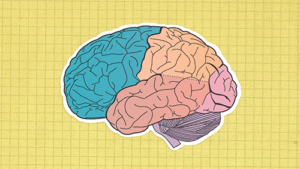
The pre-frontal cortex is located in the front of the brain. This is a part of the brain that regulates attention, mood, and motor activity. Persons with ADHD tend to have less activity in the pre-frontal cortex when compared to persons without ADHD. According to Dr. Briscoe, “The stimulant medications act to stimulate the pre-frontal cortex in persons with ADHD, and thereby improves the ability to regulate attention, mood, and motor activity.”
By acting to stimulate the function of the pre-frontal cortex, stimulant medication actually improves regulation of attention and motor activity, thereby reducing hyperactivity.”
This video sums up how ADHD medication can reduce symptoms by stimulating the pre-frontal cortex.
The bottom line: Ritalin is a stimulant, but it can help with hyperactivity.
What Are Other ADHD Myths?
Unfortunately, this isn’t the only myth about ADHD, but we’re committed to sharing the truth about ADHD. You can read more about the most common myths in these posts:
Your Next Steps
Medications can help significantly in all the areas we discussed, but it’s essential to remember that skills-building (i.e., learning strategies and tactics to cope with ADHD) is equally important. At Next Step 4 ADHD, we are all about comprehensive holistic care so that you or your child can live your best life.
Trying to deal with ADHD on your own can be difficult, but with our innovative approach, you’re never alone. We are here to guide you with your next steps. If you’d like to learn more about us or set up a confidential discussion with one of our professionals, you can complete this form for a virtual appointment. Alternatively, call our Louisville, Kentucky office at (502) 907-5908.
Learn More
ADHD Myth Series: Is It Okay to Stop Taking ADHD Medications on School Breaks?
With summer drawing closer and closer, many parents of children with ADHD start to wonder if they should pause their child’s ADHD medication during the school break, but is this a good practice for children with ADHD? We’ve interviewed Dr. Brian Briscoe to help us de-bunk this myth.
What’s a Medication Holiday?
A medication holiday is a “deliberate interruption of pharmacotherapy for a defined period and for a specific clinical purpose,” according to a study published in the Journal of Psychosocial Nursing and Mental Health Services. Sometimes medication holidays are used to assess the efficiency of a certain type of medicine.
However, there are many myths surrounding ADHD, including that it’s okay to take a medication holiday from ADHD medication on weekends, school breaks, and summer vacations. This can be problematic for a few reasons.
Consequences of a Medication Holiday
Stopping any type of prescribed medication suddenly can cause problems. Research shows that medication holidays can increase the risk of “destabilizing patients, difficulty in distinguishing [between] rebound and discontinuation effects, and increasing the risk of poor medication adherence.”
In addition, children may need their medication for more than just improving school performance.
ADHD Affects All Aspects of Life
ADHD affects all aspects of life — not just school or work performance. This means that your child’s ADHD medication affects more than just his or her performance in school.
ADHD can affect your child’s:
- Home life
- Relationships
- Ability to manage emotions and impulsivity
In other words, to stop ADHD medication over a school break can impact your child’s ability to successfully navigate through his or her life. For example, he or she may start to struggle with projects and daily tasks at home.
Dr. Briscoe highlights how quickly stopping the medication can compound problems: “When things pile up at home — incomplete projects, dishes, laundry, etc. — it can create problems on the home front, as well as anxiety for the person who suffers from ADHD.” This is true for both adults and children. Children might feel overwhelmed by incomplete chores, etc.
This means that a sudden break from medication can extend far beyond school or work performance.
The Effect of Medication Holidays on Relationships
Remember that ADHD affects relationships, and that’s true for children, too. ADHD can affect the ability of children to engage in — and stay focused on — conversations. Some children with ADHD can struggle to manage intense emotions, and some may struggle with tendencies to act before thinking, to act on impulse. (Keep in mind that impulsivity is one of the categories of symptoms of ADHD.)
Medication can help reduce the severity of symptoms in your child, and when symptoms are managed, it’s easier for your child to engage in relationships.
ADHD Medication & Behavior
ADHD medication can help your child manage his or her behavior whether school is in session or not.
According to Dr. Briscoe:
Children with ADHD experience difficulty regulating their behavior just as much at home as they do at school. As children’s behavior (i.e., hyperactivity, impulsivity, difficulty regulating attention, follow through, etc.) wears on parents and other caregivers, caregivers can begin to show signs of impatience, and sometimes speak in ways that may be a bit discouraging to a child.”
As parents become frustrated, the child can then “internalize these messages (‘I can’t get anything right’, ‘I’m lazy,’ ‘I’m stupid,’ ‘I’m a bad kid’), which can have negative impacts on their self-esteem and overall mental health on a long-term basis.”
The Takeaway
ADHD medication can help a child in all aspects of his life, including:
- Home life
- Relationships with family members and peers
- Regulating behavior
- Managing emotions
To take a break from medication solely because a child is out of school can cause repercussions in other areas of your child’s life. If you do have concerns about your child’s medications, including side effects or dosage questions, it’s important to speak to your child’s provider. Never stop a prescribed medication or adjust dosage unless directed to do so by a mental health professional. That’s because suddenly stopping certain medications can cause withdrawal symptoms, even if you take your medication as directed.
Other ADHD Myths
Unfortunately, this isn’t the only myth about ADHD, but we’re committed to sharing the truth about ADHD. You can read more about the myth about outgrowing ADHD here.
Your Next Steps
Medications can help significantly in all the areas we discussed, but it’s essential to remember that skills-building (i.e., learning strategies and tactics to cope with ADHD) and effective parenting techniques are equally important. At Next Step 4 ADHD, we are all about comprehensive holistic care so that your child can not only survive, but thrive with ADHD.
Trying to deal with your child’s ADHD on your own can be difficult, but with our innovative approach, you’re never alone. We are here to guide you with your next steps. If you’d like to learn more about us or set up a confidential discussion with one of our professionals, you can complete this form for a virtual appointment. Alternatively, call our Louisville, Kentucky office at (502) 907-5908.
Learn More

3 Strategies for Organizing Your Thoughts (and Increasing Your Productivity)
Are You Part of the 54%?
A survey conducted by the National Association for Professional Organizers found that a whopping 54% of Americans struggle with disorganization and clutter. If you have ADHD, it can be even more challenging to overcome the clutter.
But disorganization isn’t limited to just physical clutter. Disorganization can apply to your thoughts too. If you feel like your brain is flooded with too many thoughts, you’re not alone.
In this post, we’ll cover:
- How our brains are like computers
- 3 simple tips for organizing your thoughts
- How to reboot your brain to increase productivity
- How we can help you take your planning skills to the next level
Your Brain Is a High-Tech Computer

Your brain is so amazing. Just think of all of the bodily functions and processes your brain is controlling – without you even telling it to! For example, your brain stem controls involuntary muscle movements such as the beating of your heart.
But – like a computer – sometimes the brain can get bogged down with too many thoughts, or files. When the brain is overloaded, it can slow down and lose focus. When this happens, you might say “your brain feels fried” or that “you’re just frozen.” An overloaded brain can often lead to missed deadlines, forgotten details, and difficulty concentrating.
And what happens when your computer gets frozen? You re-boot!
Re-Boot Your Brain
There are many strategies for organizing your thoughts and re-booting your brain, but today, we’ll focus on three ways you can empty your thoughts, re-organize your brain, and improve your focus.
A restructured mind is much more efficient than a constantly overloaded one.
3 Simple Ways to Organize Your Thoughts
Choose the Right Time
Organizing your thoughts isn’t really something you can do while working out, washing dishes, or trying to work. It’s important to set aside time specifically dedicated to organizing your thoughts.
Find the time that works best for you. For example, you may find that first thing in the morning works great. On the other hand, you might want to sip a cup of coffee or a take quick walk around the block to allow your brain time to wake up.
You only need a few minutes, but make sure you’re fully present during this time.
Select Your Method of Logging Your Thoughts
This step focuses on getting your thoughts out of your mind and onto paper (or into a note-taking app.) This allows you to “park” your ideas until you have time to thoroughly address them.
Ideas for logging your thoughts include:
- A notebook
- A planner
- Note apps on your phone or tablet
- Productivity apps or programs (such as OneNote)
- Voice recording feature on your phone
Whatever tool you choose, make sure it’s tangible. Keeping this list in your head can clog up your brain power.
Get Your Ideas Out
If you have too many thoughts swirling in your head, it’s hard to focus on any one of them. During this step, write out everything on your mind, including:
- To-do list items
- Thoughts
- Questions
- Ideas for future projects, etc.
At first, you don’t have sort these items. The first step is to get the ideas out of your head. Once all of your thoughts are on paper, it will be easier to sort them into actionable items.
Now that your thoughts are written out, ask yourself which items are necessary for today.
If the answer is yes, then follow these steps:
- Add that item to your to-do list for the day
- Cross it off as you complete it!
If the answer is no, then follow these steps:
- If your thought is an “idea for a project”, then add it to a file specifically dedicated to your ideas that you can return to when you have more time.
- If your thought is a more of a “question”, then schedule time later to research the problem, or send out an appropriate email, or make a phone call about the problem, etc.
- If your thought is a task that needs to be dealt with soon (but just not today), then schedule it in your planner or calendar for the appropriate day.
You can repeat these steps daily or even twice a day, if needed.
A Small Habit That Works
When you’re able to organize your thoughts, you’re no longer constantly badgered by swirling thoughts in your head. Getting your thoughts out allows you to organize them. In the end, this one small habit helps you quiet your mind, decrease your stress levels, and spend more time doing the things you love. You’ll be better able to focus, concentrate, and prioritize your attention
We Can Help You Get Organized

Planning and organizing are two very important executive function skills. These are skills that many people with ADHD struggle with, but these are skills that can be taught. At Next Step 4 ADHD, you can learn the skills you need to get organized with our 5-week, online course: Planning and Organizing for Adults.
Planning and Organization for Adults is a 5-week interactive course that includes skill-building lessons and activities, live webinars, and personalized coaching support. If you are struggling with tasks such as paying your bills, showing up to appointments, or remembering to do certain items; this program offers you an opportunity to learn and apply tactics taught to you by Keri Knight, LCSW so that you can live a happier, stress-free life.
Want to Learn More?
Dealing with ADHD on your own can be difficult, but with our innovative approach, you’re never alone. We are here to guide you with your next steps. If you’d like to learn more about us or set up a confidential discussion with one of our professionals, you can complete this form for a virtual appointment. Alternatively, call our Louisville, Kentucky office at (502) 907-5908.
Learn More
Myth: ADHD Only Affects Kids
Did you know that ADHD wasn’t always called ADHD? In fact, it used to be called hyperkinetic disorder of childhood. This name insinuated that ADHD affected children only. However, this isn’t the case.
In 1987, the American Psychological Association (APA) revised the DSM-III to reflect a new name: attention deficit hyperactivity disorder. Despite the name change, we continue to see a common misunderstanding that once a person reaches adulthood, he or she can outgrow ADHD. This is a myth.
In this post, we’ll cover:
- The root of the myth
- How ADHD impacts adults
- How we can help
ADHD Doesn’t Just Affect Children
According to CHADD’s National Resource Center on ADHD, 10 million American adults have ADHD. That’s roughly 4.4% of the adult population in America, according to the National Institute of Mental Health.
Because the earliest definitions of ADHD (in the first half of the 20th century) focused only on children, many people who were treated for childhood ADHD ceased treatment when they reached adulthood. But their symptoms didn’t go away. These individuals continued to struggle distractibility, regulation of attention, organization, time management, maintaining focus in conversation, impulsivity, and other issues related to ADHD.
In the late 1990s and early 2000s, researchers began to study adult ADHD more intensively. Thanks to advanced brain imaging studies and further research, researchers concluded that the majority of cases of childhood ADHD continue into adulthood. This is because ADHD is a brain-based condition with documented, structural differences in the brain. These structural differences don’t go away as a person matures. You can’t outgrow ADHD.
So how did we end up with this myth?
Adults may have had more time to learn strategies for managing symptoms. It’s also possible that the severity of the symptoms change over time. For example, a child may struggle sitting in a desk all day long, but if he grows up and enters a career that doesn’t require sitting at a desk, he may not struggle with that specific symptom as much.
How ADHD Impacts Adults
Adults with ADHD may also have difficulties with executive function. Recently, deficits in executive function — which includes task initiation and sustained attention — have been shown to be key factors that affect both academic and career success.
Executive functioning skills refer to a set of skills that help you manage thoughts and actions.”
Adult ADHD symptoms may include:
- Impulsiveness
- Disorganization of thoughts
- Poor time management skills
- Problems focusing on a task
- Trouble multitasking
- Excessive activity or restlessness
- Problems prioritizing and/or planning
- Low frustration tolerance
- Frequent mood swings
- Problems following through with and completing tasks
- Hot temper
- Trouble coping with stress
- Attentional control
Untreated, ADHD in adults can lead to difficulties at work and home. It can cause serious problems in an adult’s academic work, professional career, and even personal relationships.
The good news is that additional research has proven that treatment for adults can be very helpful.”
It’s never too late to get help. Even better, the right kind of help can make all the difference when it comes to reaching a person’s full potential.
Treating ADHD in Adults
Whether you are new to ADHD or have been living with ADHD for a long time, you can be quickly overwhelmed with misinformation and rumors surrounding ADHD. That’s why education is often a critical first step to gaining a better understanding of how your ADHD affects your life and relationships.
Keri Knight, LCSW states: “The right education can help you and your loved ones clear up any misconceptions, and it also reduces the unproductive blame and guilt that many people and families experience with ADHD. It can be a relief to know that the difficulties with memory, organization, and attention are symptoms, not character flaws. In fact, education is almost universally agreed upon as the necessary first step in treatment.“
In addition to educating yourself on ADHD, you may also benefit from:
- Coaching
- Therapy
- Medication
- Lifestyle changes, such as improved diet, exercise, and better sleep.
With the right treatment, you can thrive!
You’re Not Alone on This Journey
At Next Step 4 ADHD, we offer complete support and comprehensive treatment for adults, adolescents, and children who struggle with ADHD. We strongly believe that simply medicating the problem doesn’t fully address the issue. There are skills you can learn and develop.
More importantly, our team of professionals offers an ongoing support system when you need it.
Dealing with ADHD on your own can be difficult, but with our innovative approach, you’re never alone. We are here to guide you with your next steps. If you’d like to learn more about us or set up a confidential discussion with one of our professionals, you can complete this form for a virtual appointment. Alternatively, call our Louisville, Kentucky office at (502) 907-5908.
References:
- https://www.ncbi.nlm.nih.gov/pubmed/4463400
- https://www.nimh.nih.gov/health/statistics/attention-deficit-hyperactivity-disorder-adhd.shtml
- https://www.healthline.com/health/adhd/history#1980